8 Things to Consider for Black History Month
*This was reposted from http://magazine.loyola.edu/issue/opinion/6080/8-things-to-consider-for-black-history-month

By Brigid Darragh
February 4, 2014
The Association for the Study of African American Life and History has selected Civil Rights in America as this year’s theme to mark the 50th anniversary of the 1964 Civil Rights Act.
Signed into law on July 2, 1964, by President Lyndon B. Johnson, the Civil Rights Act outlawed major forms of discrimination against racial, ethnic, national, and religious minorities and women. It made illegal the unequal application of voter registration requirements and racial segregation in schools, at the workplace, and by public facilities.
Fifty years following the signing of this landmark piece of legislation into law, what should we be thinking and talking about this month?
Kaye Whitehead, Ph.D., offers some topics to consider.
Whitehead is an assistant professor of communication and African and African American Studies at Loyola University Maryland.
She is also a historian and Master Teacher in African American History, and a three-time New York Emmy-nominated documentary filmmaker.
Her new book, Sparking the Genius, expands on a lecture about Carter G. Woodson’s 1933 work, The Mis-Education of the Negro, which challenged readers to think about the importance of sparking the genius in young people in a world where obstacles for race, gender, and religion still prohibit people from becoming who and all they might be.
This month, Whitehead will be giving talks at several universities and conferences around the country on Black history, contemporary issues, and Sparking the Genius, which hit bookstore shelves last week.
She will be discussing the following in her classes and on public radio during Black History Month.
The 50th anniversaries of:
1. Freedom Summer
Also known as the Mississippi Summer Project, Freedom Summer was a campaign launched in June 1964 with the goal to register as many African-American voters as possible in Mississippi, which had a history of excluding blacks from voting.
It was organized by the Council of Federated Organizations (COFO), a coalition of the Mississippi branches of the four major civil rights organizations (SNCC, CORE, NAACP and SCLC).
The Mississippi Summer Project set up dozens of Freedom Schools, Freedom Houses, and community centers in small towns throughout the state to aid African Americans.
2. The deaths of Schwerner, Chaney, and Goodman
Three American civil rights workers were killed by members of the Mississippi White Knights of the Ku Klux Klan, the Neshoba County’s Sheriff Office, and the Philadelphia Police Department in Philadelphia, Mississippi, in June 1964, for their participation in Freedom Summer and helping blacks to register to vote.
Their murders sparked national outrage and a massive federal investigation; outrage over their deaths assisted in the passing of the Civil Rights Act of 1964 and the Voting Rights Act of 1965.
3. The founding of the Organization of Afro-American Unity (OAAU) by Malcolm X
The goal of the OAAU was to fight for the human rights of African Americans and promote cooperation among Africans and people of African descent in the Americas. The OAAU also focused on voter registration, school boycotts, housing rehabilitation, rent strikes, and social programs for addicts, unwed mothers, and troubled children.
4. The Harlem Race Riots
Riots broke out in the Harlem section of New York City following the shooting of James Powell in July 1964. The incident set off six consecutive nights of rioting that affected the neighborhoods of Harlem and
Bedford-Stuyvesant. Four thousand people participated in the riots, vandalizing, looting, and attacking the New York City Police Department.
The Harlem Race Riot is said to be the precipitating event for riots that took place later that summer in Philadelphia, Rochester, Chicago, and in several cities in northern New Jersey.
5. The founding of the Mississippi Freedom Democratic Party (MFDP)
Created in Mississippi during the civil rights movement, the MFDP was organized by black and white Americans and sought to challenge the legitimacy of the white-only U.S Democratic Party.
6. Dr. King and the Nobel Peace Prize
Fifty years ago, at the age of thirty-five, Martin Luther King, Jr., was the youngest man to have received the Nobel Peace Prize. When notified of his selection, Dr. King announced that he would give the prize money of $54,123 to the furthering of the civil rights movement.
As for contemporary black history issues, Whitehead will be discussing Black Twitter and the Classroom to Prison Pipeline.
7. Black Twitter is a modern trend that is changing the way people discuss and take action on current issues and events, one hashtag at a time. Defined as a “cultural identity” on the Twitter social network, it focuses on issues of interest to the black community.
“Black Twitter is a place where African Americans meet on social media to talk about an issue or share information. There’s a movement behind it, and some of the things that trend are really good and can make a change. It gets other things to trend that are of importance or relevance,” Whitehead says.
Black Twitter has gained momentum during such events as the George Zimmerman trial following the fatal shooting of Trayvon Martin in February, Fast Company’s list of the top 25 most influential females in business (in which not a single black woman was recognized), and Paula Deen’s racist comments on television, to name a few from 2013.
“It can be a very effective organizing tool because it’s used as a way to organize and talk about issues, and it can also have a revolutionary side,” says Whitehead.
What’s trending on Black Twitter now?
“A lot of black poetry. Also the notion of Black History Month versus BH365—shouldn’t we be celebrating year round?”
8. The Classroom to Prison Pipeline refers to the one million African American people who are currently incarcerated in the United States. According to a 2012 study, roughly 2.3 million people are in prison in the U.S.
“We are finding there are more and more students who get to high school, drop out at age 16, and end up in prison. They are not being pushed towards college or a trade,” Whitehead explains.
“In 2012, 84% of African American fourth graders were reading below grade level. The same year, 47% of African American males dropped out of high school at age 16. With those statistics in mind, where else are you going but prison? You can’t read, you can’t write, you don’t have the basic tools needed for a job,” Whitehead says.
Her book, Sparking the Genius, poses the challenge of sparking the genius in the young people around us: “How do we dismantle and disrupt this classroom to prison pipeline? How do we get young people studying and reading? How can we get students to have a better knapsack of all the things they need to succeed?”
Whitehead believes the key is to foster the ability for students to imagine themselves somewhere different, more than what they are now, better than current circumstances.
“If we can we get them to close their eyes and see where they want to be—and then open their eyes and make that happen—we can create change.”
Whitehead joins Marc Steiner on the Marc Steiner Show on Wednesday, February 5, to talk about these issues and more, and she will be blogging about Black History throughout the month on her website.
Her second book, Notes from a Colored Girl: The Civil War Pocket Diaries of Emilie Frances Davis, is due out in May.
Sparking the Genius: The 2013 Carter G. Woodson Lecture
On The Road to Becoming the Person that You Were Born to Be!

Sparking the Genius: The 2013 Carter G. Woodson Lecture
Author: Karsonya Wise Whitehead
Publisher: Apprentice House
Cover art by Calvin Coleman
Edited by Ronald J. Harrison
At the front of my new book, “Sparking the Genius: The 2013 Carter G. Woodson Lecture,” I include a poem for my children to spark their genius where I encourage them to “Commit themselves to becoming the people that they were always meant to be.” This idea, of using words to spark their genius, was taught to me by my father after he read Carter G. Woodson’s book, “The Mis-Education of the Negro.” Woodson argues that,
“The same educational process which inspires and stimulates the oppressor with the thought that he is everything and has accomplished everything worth while, depresses and crushes at the same time the spark of genius in the Negro by making him feel that his race does not amount to much and never will measure up to the standards of other peoples. The Negro thus educated is a hopeless liability of the race.” [emphasis added]
My dad said that his job as a father consisted of more than just bying shoes and clothes; but, that he was charged with a lifelong mission to spark my genius and teach me how to spark the genius of everyone around me. In 2013, when I was first asked to deliver the Woodson Lecture at the 2013 ASALH Convention, my goal was to write something that could be used to help to spark the genius of every young person who was struggling with trying to understand who they are and why they are here. To that end, I wrote the Lecture and worked to have it published as a book. It is my small contribution to add to the arsenal of weapons that we need in order to save every young person in our community in an effort to save our community. It is a lofty goal but I believe that if everyone contributes something to the arsenal then our bag of tricks, weapons, tools will never be empty.
And, if you combine this arsenal with our desire to save, rescue, and transform the young people around us then we will be able to (in the words of my father) “spark their genius, set them on fire, and set them loose into the world.” Finally, I believe that there is a place that exists beyond our current reality, beyond our unfulfilled dreams and broken promises, beyond poverty and crime and illiteracy and abuse, a place that exists —only at this moment— in our dreams. A place that we can only get to by sparking genius, shifting gears, and changing the current narrative. The Woodson Lecture is designed to be used as a road map to guide us along the way.
For Mongi omkhulu Leita Phakathi and Tata Madiba (Nelson Mandela)

English: Young Nelson Mandela. This photo dates from 1937. South Africa protect the copyright of photographs for 50 years from their first publication. See . Since this image would have been PD in South Africa in 1996, when the URAA took effect, this image is PD in the U.S. Image source: http://www.anc.org.za/people/mandela/index.html (Photo credit: Wikipedia)
“Ukufa yinto engenakuthiwani bani. Xa umntu sele elufezile olwakhe ugqatso, elusebenzele uluntu nelizwe lakhe, anganduluka aye kuphumla ngoxolo. Ndiyakholwa ke ukuba ndizenzile ezo nzame, kwaye kungoko ke, nam ndiya kulala ukuthula.”
(“Death is something inevitable. When a man has done what he considers to be his duty to his people and his country, he can rest in peace. I believe I have made that effort and that is, therefore, why I will sleep for the eternity.”)
–Tata Madiba

My sister, Dialiita Leita Phakathi
I woke up this morning thinking of two people, Tata Madiba and Dialiita Leita Phakathi. One was an international icon, a Nobel Peace Prize Winner, and a former president and the other was an unknown domestic without a husband or children. Both of them were born in South Africa and were Xhosa. He was born into the Thembu royal family, attended the Fort Hare University and the University of Witwatersrand. She never finished high school though she, like him, wanted to study law and work for her people. I have never met either one of them but both have influenced my life in ways I could have never imagined.
II. LEITA PAKATHI
In 1995, I led a group of college students to South Africa to work in Acornhoek, building houses and teaching children. We knew that Nelson Mandela had been free for three years and that he had been working with de Klerk to organize a democratic election in the country. We were excited and anxious to see if and how the country had changed since his release. There were ten of us in the group: seven African Americans (six women and one man), two white women, and one Asian American man. When the plane landed in South Africa, we clapped and cheered as some people kissed the ground and others begin to cry. Our host was Geoff Phakathi, a South African freedom fighter, a teacher, and a self-proclaimed rebel. He was six-feet tall and had a loud voice and a delightful habit of saying “boom” at the end of every sentence that he thought was significant. “We will have democracy in this country or we will all die trying. Boom!” or “I will drive you by Winnie’s house and if you yell loud enough she just might come out and tell us to go away. Boom!” I loved him as soon as he started calling me sister and welcoming me home. “Since you black Americans don’t know where you’re really from,” he told me, “you might as well claim South Africa. Boom!” He took us everywhere, from the shanty towns of Soweto where we witnessed cows and children drinking from and using the bathroom in the same stream to the all white neighborhoods of Johannesburg where most of the houses had an armed black guard sitting at the front gate. Right before we left the country, after introducing us to Nadine Gordimer and some of his fellow rebels, he told me that he needed a favor. His sister, Leita, had passed away many years ago and instead of throwing her passbook into the fire, he had decided to keep it as a way to remember her. He wanted me to take it back to America, a place where she had always dreamed of visiting. He said that I reminded him of her and that I was doing and had done so many of the things that she had always talked about. “Keep her memory alive,” he said that night while wiping tears from his eyes, “and if there are times in your life when you think of giving up and letting go, think of Leita, and just hold on a little bit longer because help is on the way. My sister wanted to be there when Madiba was released so she could greet him and thank him, since she couldn’t, I did it for her. Every time I thought about letting go, I thought about Leita and just held on a little bit longer.” I keep her passbook on my wall as a reminder of what true struggle looks like and what it means to hold on just a little bit longer.
III. TATA MADIBA
There are only a few days that go by where I do not think about Nelson Mandela. I keep a picture of him near my computer as a reminder of what sacrifice and courage look like. I thought about him this morning and about how—unlike our leaders (Martin Luther King, Jr., Malcolm X, Medgar Evers, George Winston Lee, Jimmie Lee Jackson, to name just a few)—he lived for such a long time. He was 95 years old! Over the years, we have watched as he has grown older and matured. We laughed and cheered when he walked out of prison with Nomzamo by his side and his fist held high. We prayed for him and his safety during the first democratic election when he became the president of a country that had imprisoned him for 27 years! We cried with him and sometimes (and I think now of the “Free Mandela” movement) we cried for him. Mandela is one of the few people that I wish I could have met. I am sure that like many others, I probably would have just sat there without saying a word, happy to be in his presence. I grew up admiring Dr. King but I became an activist because of Madiba. I studied black history because of Barbara Jordan but I studied African history because of Madiba. I traveled abroad because my father urged me to go but I traveled to South Africa because I felt as if Madiba was calling me home.
What I admired most about him was that he was not a mythological figure. He did not walk on water or perform miracles. He was a man and like all men he was flawed; but, it is in his flaws where we find hope because if he could forgive his captors and oppressors then so could we. In 1990, while I was studying abroad in Kenya, I remember reading about the Soweto uprising (16 June 1976) and about all of the men, women, and children who died on that day, the nameless and faceless foot soldiers who gave their lives (willingly and in many cases, unwillingly) in the struggle to end apartheid. I realized then that this was probably going to be Mandela’s reality if he were ever released. He would be working to build a new political and social system while others, were either openly or secretly working against it and him. Despite the increasing violence and horror and the passing of the years, Mandela stayed the course, pressing forward toward the mark to finish the race.
When I used to teach my sons about Mandela, they wanted to know how one man was able to move an entire country beyond apartheid and hatred and violence to a place where they could unify and become one nation. I told them that this change never would have happened if Mandela had worked alone. Apartheid would not have ended, democratic elections would have never been held, and the violence would never have stopped. It took the effort of many, encouraged by the commitment of just a few, for real change to take place.
Sometimes I wonder what it would take to move our country to a place where racism and discrimination are things of the past, not just in policy but in practice and even more important, in the hearts and minds of all of America’s children. We, as a nation, have moved beyond Jim Crow. We have moved past the marching and the singing. We have seen African Americans prosper and aspire and ascend to some of the highest offices in the land; but, on quiet Sunday mornings while my sons are still asleep, I wonder how much we have changed and whether or not we are still committed to changing. We have so much work to do in this country and unfortunately, we do not have (and have not had for a very long time) a Tata Madiba—a man or a woman who is willing to put everything on the line to push, encourage, cajole, and force our nation to reach a place where all doors are open, all hearts are able to sing, and men, women, and children of all races can find a resting place. There are some who believe that the days of having just one leader have come and gone and although I agree with them, there is a small part of me that longs for one person to unite us all and lead us in the same direction.
IV. HOLDING ON AND LETTING GO
I mourn for both of them: for Mongi omkhulu Leita who never experienced a day without apartheid, never had a chance to vote, move freely through her county, and whose life ended far too soon; and, for Tata Madiba who moved mountains, changed lives, ran the race, and stayed the course.
Related articles
Southern Fried Christian Feminism
I. Alone
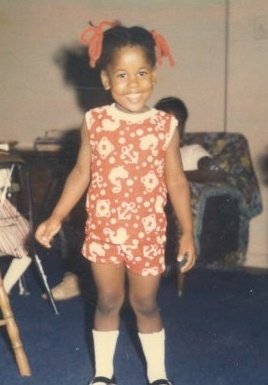
I spent the day thinking about my grandmothers, Nana and Red, as I slowly started to realize that for the first time in my life, I am without any grandparents. I grew up with both sets of my grandparents and my maternal great grandparents. I was well into my twenties before I started to lose them, one-by-one. The first was my paternal grandfather who was hit by a speeding car as he was driving along the highway coming from the fields on his tractor. He was a good man and was known for being kind and honest. A few years later, while I was studying in Nairobi, Kenya, my maternal great grandfather maternal great grandfather was diagnosed with prostate cancer. I remember that when I received the letter telling me that he was sick, it took me an hour to get down to the city and call home to check on how he was doing. I was told that he had already gone home and that he sent his love. That night, I walked around Chemundu so that I could find a place to sit quietly in the darkness and say goodnight.
My Nana had always told me that when a person passed away, it was simply a visual representation of the ending of the sunset on this life and the beginning of the sunrise on the next. We were never to say good-bye, only goodnight, confident that we were going to meet them again at daybreak. My paternal grandmother, Red, passed away next. She had both a brain aneurism and a blood clot but I believe, after spending hours at her bedside, that she died of a broken heart. She was one of my favorites because she knew who she was and she never wavered whenever she knew she was right. I was three-months pregnant with my first child when my maternal great grandmother pass away. I was devastated as I had hoped that she would live long enough to greet and hold the fifth generation. It was only a year later when my maternal grandfather, Dee-Dee, was diagnosed with prostate cancer. I rushed down to South Carolina so that I could see him before he died and so my son would have a chance to say goodnight. died next. He lived two years longer than they thought and he was in unbearable pain every single day. By the time, he reached the end we were all praying for the Lord to take him home.
It would be seven years before my maternal grandmother, Nana, would run on ahead to see how the end is going to be. She was not sick. She did not have heart problems or cancer or any type of illness, she just decided that she was tired and she was ready to go home . She simply made up her mind and stopped eating and drinking. She survived for three months before her body finally got in line with her spirit and sat down and rested.
I come from a long line of strong willed Southern Christian feminist women. They taught me, either through their words or their deeds, how to meet every challenge with dignity and with grace. I may have been the first woman in my family to get a Ph.D. but I was not the first woman to struggle and sacrifice for a goal that only I could see.
Excerpt from “Letters to My Black Sons: Raising Boys in a Post-Racial America” (Apprentice House, 2015) https://www.apprenticehouse.com/?product=letters-to-my-black-boys-raising-sons-in-a-post-racial-america
Cancer Breaks All the Rules! (Excerpt from “Letters to My Black Sons: Raising Boys in a Post-Racial America” Apprentice House, 2015)
“When someone you love gets diagnosed with a terminal disease, your life as you know it stops working”
(Originally published in The Baltimore Sun on 11/6/2013)
©2013 by Karsonya Wise Whitehead

Florence Whitehead Huzzey (November 24, 1946 – April 23, 2013)
REFLECTIONS
I hate losing. I hate it when I lose my keys, lose my way, or lose my train of thought. I have spent my life trying to learn the rules of every game that I played in an effort to ensure that I was always prepared and that I had everything that I needed to be victorious. The game always made sense to me when I knew the rules. I respected the boundaries and I fought hard. I am not accustomed to or comfortable with losing, and that is why I am having a difficult time.
Earlier this year, my dear sweet mother-in-law passed away, less than three months after being diagnosed with Stage IV lung cancer that had metastasized from her lungs to two places in her brain. When we were first told that she was sick, I kept telling myself that times had changed, medicine had gotten better, and the field of medicine had been revolutionized, but, in so many ways, it has not. There is no cure for terminal cancer, and there is nothing worse than having a doctor tell you that there is nothing that can be done to cure you or a loved one. Nothing. At all. My mother-in-law, Florence Whitehead Huzzey, went from being a robust and vibrant person to being on complete bed rest in less than a month. She went through six weeks of radiation to the brain, and because of it, her body was acting like she had had a stroke, so her left side stopped working. In so many ways, so did we.
When someone you love gets diagnosed with a terminal disease, your life as you know it stops working. You lose touch, and you lose track of time. The days slip by, and though you are going to work or to school, you are not fully present anywhere. It is as if the universe demands everything you have to give and makes you focus all of your attention and energy on trying to keep your loved one alive. I could feel myself almost trying to will her back to good health.
Cancer became real to me, and it was everywhere. I would hold conversations with cancer and demand that it answer my questions about what I could do to force it to leave mother-in-law alone. I got angry at cancer. I fussed at it, ignored it and apologized to it. In my mind, cancer was like a spider that had caught my mother-in-law in a web, and everyone who was connected to her was caught as well.
Excerpt from “Letters to My Black Sons: Raising Boys in a Post-Racial America” (Apprentice House, 2015) https://www.apprenticehouse.com/?product=letters-to-my-black-boys-raising-sons-in-a-post-racial-america
FACTS:
1. Lung cancer is the second most common cancer and the number one cancer killer. Worldwide, lung cancer is the most common cancer in terms of both incidence and mortality.
2. The most common cause of lung cancer is long-term exposure to tobacco smoke, which causes 80–90% of lung cancers.
3. Prognosis is generally poor. Of all people with lung cancer, 15%-16% survive for five years after diagnosis. The Stage is often advanced at the time of diagnosis.
Related articles
- How to Prevent Lung Cancer (oxygenconcentratorstore.com)
- What is Lung Cancer? (oxygenconcentratorstore.com)
Letters to My Tweenage Son (Part IV)
CHILDHOOD MEMORIES
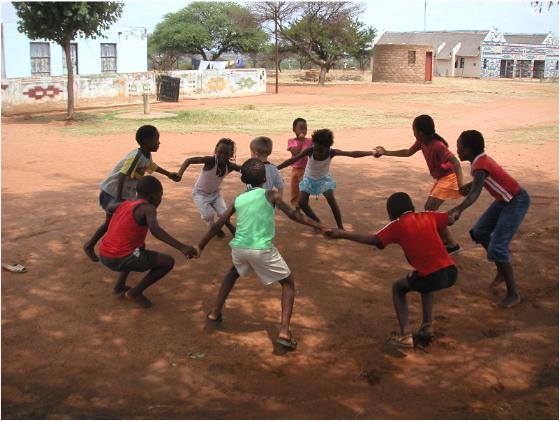
from nowpublic.com
©2013 by Karsonya Wise Whitehead
Dear Buddy:
Nikki Giovanni once wrote that, “childhood remembrances are always a drag if you’re black” and when they write your story about your childhood they will never realize that in the midst of the struggle you were quite happy.* I have come to believe, as I tell myself my childhood stories, that my memories are both real and imagined. I feel like I have to preface every statement with a disclaimer that everything that I remember is real, whether it happened or not. My memories and experiences have shaped and molded me. I have found that these two things are separate because both the way that something happens and the way that I interpret and remember something happening to me are pieces of me. I make no apologies, not anymore, not like before.
I. REMEMBERING
My earliest memories are of my father sharing his stories about his childhood spent growing up in rural South Carolina; about his adventures in the military and during the Civil Rights Movement; and, about him and my Mom falling in love with each other long before they had been introduced. At night, while some kids were getting a bedtime story about green eggs and ham, I received a history lesson about life before Brown v. Board. I remember thinking that he was just saying these things to scare me and to make me straighten up and fly right. On Saturday nights, my father would make me and my siblings hot chocolate with marshmallows. We would lay on the floor in our sleeping bags and he would sit in his easy chair and talk. We did not have a television so we would watch our father.
Our gifted and animated Griot who made the Movement come alive. I felt like I was with him when he used to walk past all of the white schools to get to his all-black one-room classroom. I used to feel the heat when he would describe the big black cast iron stove that set in the middle of the classroom burning wood throughout the winter to keep the room warm. I used to squint when he would talk about how everyone had to move to one side of the classroom in the afternoon so that they could use the sunlight to see their books. I used to shiver when he would talk about how he only had one coat and two pair of shoes—one for everyday and one pair for Sunday church. He used to wear his shoes until he got holes in the bottom and then put in cardboard and wear them until the cardboard ran down. He told us how he used to wake up hungry and spend the day thinking about food. There was just enough food to keep him from starving but not enough to make him feel full. My father shared stories about his life and how difficult it was growing up black and poor and male in the South. He believed, as did my grandmother, that the only thing that could save him from a lifetime of poverty and malnutrition was either a good education or the military. My father chose education and would study every night while making promises to himself, “If I get an A on the chemistry test, then I’m going to buy myself a honey bun.” He kept a secret ledger with a balance sheet and every time he made an “A,” he would pay himself a quarter. He would pay himself when he had to clean the outhouse or when he gave his sister the last slice of bread or when he had to pick cotton or sweep the sand out of the house. It became a game of how much could he pay himself not to complain or cry out or just stop believing that life would ever change. He promised himself that as soon as he made it, the first thing he was going to do was take his money and get everything he always dreamed about in his ledger.
II. DISCOVERING
My favorite story, and the only one that my parents would tell together, is about how they met and fell in love. They used to finish each other sentences and laugh out loud, as the details started to change once they got older. My father fell in love with my mother when he was 13 years old. Their churches used to host a joint picnic where all of the families would come together and worship. My mother was a city girl. Her mother was one of the first black nurses in South Carolina and her father worked for the railway. They used to come to the picnic in a car, one of the few families that owned one. There were eight of them, my father remembers because he counted all the kids as they got out. My mother was the last one out and he said that he knows because she swung her legs out first and he thought it was odd that her knees were shining. He said that he remembered that they day was slightly overcast because he heard it was going to rain and he thought about not coming. “She smiled,” he used to say as he eyes looked away for just a moment, “and it was like the sun had come out.” That summer my father had finally saved enough money to buy a white suit. He had worked everyday after school and had saved every single penny. He felt like a man on the day he bought the suit home in a paper bag.
My mother said she saw him out the corner of her eye. He fascinated her because she had never seen a black boy in an oversized starch white suit with the cuffs and the sleeves rolled up. She remembers that he had on white shoes and white socks as well. “He did not sit with the other kids,” she said, “he sat with the men and he talked to them like he was one of them.” My mother sat with her sisters; close enough to pretend as if she was not listening. She thought he was smart and wanted to say something to him but good girls never spoke to boys first. My father did not speak either. He just watched her whenever she laughed or walked around. He said his heart dropped when all eight kids piled back into the car. Their father did not say a word, he just got up and all of the started to move. He said they looked happy and healthy, like they ate one day at a time never worrying about whether they would eat tomorrow.
He did not see her for an entire year. On the eve of the annual picnic, he took his suit out of the back of the closest—he had hid it there so that he would not be tempted to wear it—and laid it across his chair. It fit him this summer and like before, he spent the whole afternoon sitting with the men and watching her whenever she moved. She spent the day trying to figure out whether my father was wearing a new suit or the same suit. And if it was the same suit, why was it so white? It looked like he had not worn it at all. He did not. The summer before (after he met her), he had decided that he wanted to have one nice thing for the picnic so he saved the suit. When my mom was getting ready to leave, he walked over to and introduced himself. She said he did not smile though he said he could not remember doing anything but smile.
When she saw him the next summer, she said her heart leaped. The white suit, the one that he had worn both times she saw him, was now a little too small. She could see his wrists and his ankles. He was 16 and she was 14. He talked to her this time and they sat together at the picnic. He was not thinking of marriage or commitment. He just wanted to talk to the pretty brown girl with the shiny knees. They do not remember what they talked about it, something about the future, schoolwork, traveling, and their parents. They both wanted out of South Carolina and had dreams of going to school up North. My father joined the military at 18 and though he never saw my mother at another picnic, he said he used to dream about her and tell all of his bunkmates that when he got home, he was going to find her and marry her. When he arrived at the door, my mother was shocked that he had found her and that he had been looking for her. She was 20 years old and was dating a law student from Boston. My father was ready to get married and he was ready to be married to my mother. They never told me how he won her heart (some secrets really should be just between lovers) just that he did and they were married within the year. He told that he would take her away from all of this—the racism, the South, the struggle—and they would start over with a clean slate.
III. ASSEMBLING
They settled in Washington, DC and my father worked at a gas station during the day and attended college at night. I know that he worked and went to school when I was child but I do not have any memory that does not include him. He was always there, every trip or family night or parent teacher Conference. He showed up each and every time. I remember once when my teacher started talking to me at a parent teacher Conference. My mother had stepped out to check on my sister and I was standing there by myself. My teacher looked down at me and started telling me everything that I needed to change to be a better student. I remember that my hands started shaking, as they usually do when I get upset, and right before I said anything my father suddenly appeared, took my hand, and begin to answer the teacher in my defense. He told me that night that he was my first line of defense, when I am wrong he would be the first person to correct me and when I was right, he would be the first to defend me. He was like a superhero to me, like I had my own special bat signal that I could use whenever I felt afraid or alone. (Little girls need their fathers to be superheroes, catchers in the rye.) My father worked hard so that my childhood memories would not be a drag. I remember that I was never hungry, I never thought about food, or wore shoes lined with cardboard. I never used an outhouse or had to boil water to take a shower. I never had a ledger because I had my daddy. I remember summer vacations, hot chocolate, and stories about the Movement. I remember laying on my daddy’s shoulder and always feeling like it was put there just for me.
I often wonder how my father changed his economic situation. I now believe that it was a combination of things. The first is that he enlisted in the military and by doing so, he received a monthly income, healthcare, and a housing allowance, which allowed him to save a large portion of his pay. Next, my father is educated and was committed to receiving a college degree. He later earned both his Master’s Degree and his Doctorate of Ministry so it was easy for him to transition from blue-collar to white-collar jobs. Additionally, my mother supported my father’s dreams and though she could not “see” them, she believed that they were real and attainable. She was a stay at home mom and she did everything she could to ensure that our home was a place of peace and love and stability. Next, and often overlooked, is that my father had opportunities to be successful. He had an uncanny ability to predict those moments when opportunity and talent would coalesce. He calls it luck, I call it being attuned to your talents and always being ready to use them. Finally, my father has grit, which is hard to describe and even harder to quantify. He has that unique ability to focus on a goal and finish it. He can will himself to the finish line despite whatever obstacles might be in his path. He is amazing. He has told me and has shown me how important it is to have your history be a stepping-stone for your destiny. It should not hold you back rather it should be seen as a necessary step that will propel you to the next level.**
IV. ACCEPTING
My father has carved out a path for me to follow and has left both his footprints and breadcrumbs to guide me through. He has told me that the path that has been carved was designed just for me; therefore, I am not in a race. Everything that is for me is for me alone. It is a journey and though there are times that I feel that I have been walking for a long time, I am still on the path and am a long way from home. My memories, both real and imagined, are my guideposts that I am using (just like my daddy’s footprints and breadcrumbs) to guide me back home. My father, your grandfather, has trained me well so I understand that as I make my way through I need to step hard and leave large breadcrumbs for you.
Until…
Mom
*Nikki Giovanni, “Nikki-Rosa.” http://www.poetryfoundation.org/poem/177827
**I am grateful to my students in my F’2013 CM330 Stereotypes course (especially Katlyn) who finally helped me to put some text around this idea. I have been wrestling for years with trying to figure out what is needed to help a person move from one income level to the next –in the words of my students it’s “the little extras.”
The Golden Jubilee of the Civil Rights Act: Notes from The Black History Bulletin (BHB) V. 76 No. 2
ReFraming the Historical Narrative:
Using the Lens of the 1964 Civil Rights Act to
Examine the Civil Rights Movement
©2013 by Karsonya Wise Whitehead
[In less than a month, the 2014 edition of the Black History Bulletin will be published. Founded in 1937, the BHB is the oldest journal for practitioners. It features articles that cover the Black History Month theme, which is introduced by the Association for the Study of African American Life and History (ASALH) and endorsed by the White House. ASALH currently distributes 15,000 copies of the BHB to middle and high school teachers and teacher educators around the country. *Historically, “academic journals” were referred to as “bulletins.” The BHB chose to retain its heritage name rather than switching to the modern term. In preparation for the upcoming publication, below is the Cover and my “Afterword” that describes each article and lesson plan in detail.]
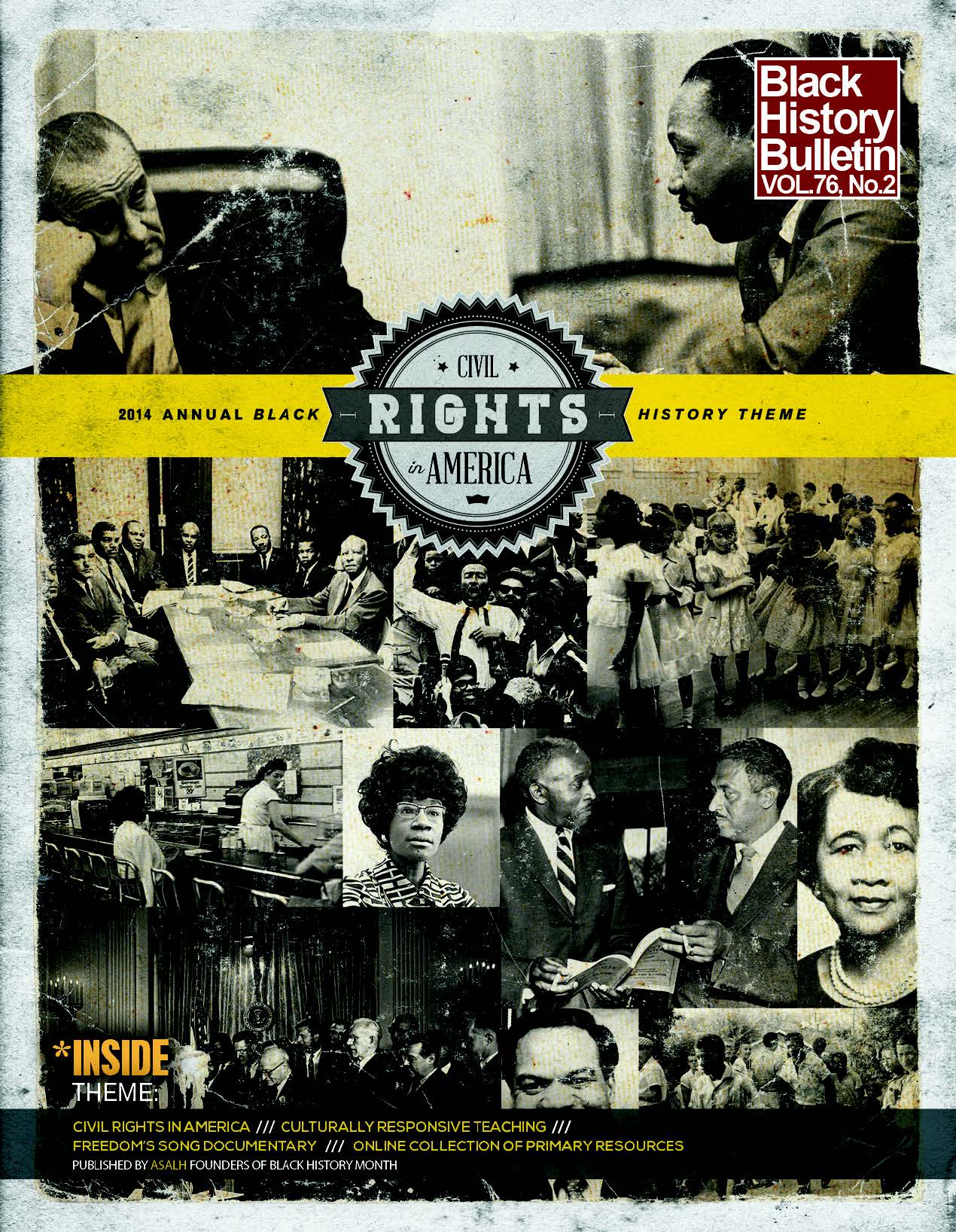
In 1954, in a landmark unanimous decision, the United States Supreme Court in the Brown v. Board decision ruled that the American system of state-sponsored segregation, which had been in place since the 1896 Plessy v. Ferguson decision, was unconstitutional and inherently unequal.[1] One year later, the Court ruled that integration had to occur within all public schools “with all deliberate speed.”[2] The ambiguous language used in the Brown II ruling was seen by many to be a victory for white southerners as it did not force them to integrate by a certain date. As a result, integration was a slow and difficult process. Since the Supreme Court does not have the ability or the right to enforce the law, black and white southerners quickly found that progress would not peacefully occur without the direct intervention and assistance of the executive branch.[3] During that time, the struggle for civil rights was a legal issue that was being defined by the American Courts but not translating into real change in the lives of its citizens.
This decision unofficially marked the beginning of the modern Civil Rights Movement, which was a period of tremendous growth and change in the political, social, and economic landscape of our country. Similar to the Reconstruction Era, this period fundamentally changed the everyday lives and experiences of black Americans. With the Brown II decision and the reaction to it, it was obvious that real progress would not occur unless there was a direct, sustained, and organized plan to confront and fight Jim Crow state by state. Civil Rights leaders and foot soldiers began to organize and change started to happen: the Montgomery Bus Boycott started in 1955; Little Rock Nine integrated in 1957, the Sit-In Movement began in North Carolina in 1960; the CORE Freedom Rides started in 1961; and, James Meredith confronted the University of Mississippi in 1962.[4] At the same time, the push to stop the slow march of freedom and integration intensified as the police, acting in concert with white southerner politicians, used a number of fear tactics, including mass arrests, aggressive attack dogs, water hoses, and lynching.
This was the environment, the one where the goal of freedom and equality for black people was being challenged over and over again, that existed when Governor George Wallace announced in his 1963 inaugural address that in the state of Alabama segregation would continue to exist today, tomorrow and forever. On June 11, as two black students prepared to enter in and desegregate the University of Alabama, Wallace in is now famous “Stand in the Schoolhouse Door,” attempted to physically block them. Even though they were peacefully admitted, it was was only because President John F. Kennedy had sent the Alabama National Guard to enforce the law. Later that day, in a live radio and television broadcast, Kennedy called on all Americans to recognize that the struggle for civil rights was a moral cause that everyone needed to not only contribute to it but be committed to it, as well. He proposed the Civil Rights Act as the means in which to bring about the change that needed to happen to free African Americans from “the bonds of injustice” so that they will finally be “fully free.”[5] Although Kennedy was assassinated seven months later, this legislation, that abolished discrimination in public accommodations, employment, and federally funded programs, was pushed through by President Lyndon B. Johnson and became known as the 1964 Civil Rights Act.
********
This issue of the Black History Bulletin called for papers that would use the lens of the 1964 Civil Rights Act to examine key moments that took place either during the modern Civil Rights Movement or during the early Civil Rights Movement (which occurred during the enslavement and Reconstruction). The 1964 Act is an incredibly complex piece of legislation to teach in the classroom as students need to have some understanding of some of the key events that were taking place that led to Kennedy’s address. They also need to understand that though the struggle for civil rights and social justice did not begin or end with the modern Civil Rights Movement, this period of time was when our nation began to shift from being two societies, “one black, one white—separate and unequal,” to being one society with freedom and justice for all.[6]
Articles and Lesson Plans
In the Gist and Whitehead article, “Deconstructing Dr. King’s ‘Letter’ & the Strategy of Nonviolent Resistance,” the authors take a close look at the practice of nonviolent resistance as it is explained in the “Letter from a Birmingham Jail” (which was released two months before Kennedy’s address). The authors examine the policy of nonviolent resistance; outline the key events that led up to the Montgomery Bus Boycott and the introduction of Martin Luther King, Jr. onto the national stage; and deconstruct both the “Call to Unity” and Dr. King’s public response. In their lesson plan, they highlight and explain how students can use Close Reading strategies to deconstruct activist writing, specifically looking at the “The Power of Non-violence,” the “Call to Unity,” the “Letter.”
Abel and Johnson, in their article “The African American Sage from Enslavement to Life in a Color Blind Society: or Racism without Race,” takes a slightly different approach in helping students to reframe the historical narrative. They divide the Civil Rights Movement into two parts, the first from 1865 to 1877 and the second from 1954 to 1965, and then provide a historical context so that students can understand how these two Movements were and are connected. In their lesson plan, students have an opportunity to “pull the history forward” as they examine primary and secondary sources to better understand the voting controversy and subsequent succession efforts surrounding the 2012 presidential election.
Since Abel and Johnson’s article explores both the modern and the historical Civil Rights Movement and the Gist and Whitehead article only focuses on the modern, the Garrett-Scott article, “‘When Peace Come’: Teaching the Significance of Juneteenth,” provides a nice complement by providing a close examination of enslavement and Juneteenth. In it, the author explains that for students to clearly understand the significance of the 1964 Civil Rights Act, they must first understand some of the smaller historical moments that set the stage for the legislation. One such moment was the Juneteenth event, which is used as a starting point to help students to explore and understand the lived reality of Americans of all races and ethnicities. In the lesson plan, the author, in partnership with two practitioners, provides three lessons where students examine the Emancipation Proclamation and Juneteenth to understand the process of freedom in social, political, economic, and cultural contexts from the 1860s to the present.
The final article, “Understanding the Local Context of the Civil Rights Movement: Using Service Learning to Develop an Oral History of Our Community,” is actually a first person essay that discusses the author’s childhood experiences in Detroit of learning about the Civil Rights Movement from people who had either participated in it or benefitted from it. Using his life as a starting point, Simmons discusses how he works with teachers and students to create oral history projects that focus on local communities. He stresses the importance of partnering with the community to expose the students to living legacies. In his lesson plan, he provides a detail guideline for how teachers can teach their students how to collect, store, and analyze first person narratives.
Each of these articles and lesson plans, either taken individually or collectively, will provide both researchers and teachers with a broad understanding of the 1964 Civil Rights Act and some of the key historical moments that paved the way for the passage of this legislation.
ReFraming the Historical Narrative
Finally, as we celebrate the golden Jubilee of the Act, it is important that we move forward—as teachers, researchers, and students of history—like Sankofa birds. We fly forward into this future that we are creating and making up along the way; and, we keep our eyes on the past so that we do not repeat the mistakes and we learn the lessons. These articles and lesson plans are designed to do both, provide us with an understanding of key historical moments as well as offer us new ways to teach and understand these moments.
[1] In 1892, Homer Plessy was arrested in Louisiana for attempting to ride in the “White” car on the East Louisiana Railroad. Although Plessey, as a Creole of color, was light enough to pass for white, he was considered to be a black person and therefore required to ride in the “Colored” car. His lawsuit against the state eventually made its way up to the United State Supreme Court, which ruled that “separate” facilities for black and white people were constitutional as long as they were “equal.” This decision, which began with the railway, quickly moved into other areas of public life including public schools, restaurants, restrooms, hotels, theaters, churches, and universities. http://www.lawnix.com/cases/plessy-ferguson.html
[2] Brown v. Board of Education, 349 U.S. 294 (1955) http://caselaw.lp.findlaw.com/scripts/getcase.pl?court=us&vol=349&invol=294
[3] As is the case in everyday life, the terms black and African American will be used interchangeably in this article.
[4] For more information on these events, see Karsonya (Kaye) Wise Whitehead, “Civil Rights Movement Timeline” http://www.visionaryproject.org/timeline/
[5] President Kennedy’s 1963 Civil Rights address http://www.youtube.com/watch?v=4cSrvqYKQH8
[6] History Matters, “Excerpts from the Kerner Report.” http://historymatters.gmu.edu/d/6545/
- Top 10 books for Black History month (theguardian.com)
Reflections On “The Reginald F. Lewis for Maryland African American History & Culture”

English: Image of American poet and activist Frances Ellen Watkins Harper. (Photo credit: Wikipedia)
I. Preserving History
©2013 by Karsonya Wise Whitehead
My son was four years old the first time he visited the Reginald F. Lewis Museum of Maryland African American History and Culture.* The Museum had just opened and we had been selected as the focus family so a reporter from The Baltimore Sun followed him and captured his excitement about experiencing black history for the first time. I remember that later that day he told me that he was proud to be black because being black meant something big. He said, “I’m going to do great things because I come from great people.” During that time, we made frequent trips down to the Museum and he became familiar with every exhibit, statute, and painting. I used to take him and his younger brother to the third floor, find a quiet corner, pull out an African American picture book, and we would sit there and read. They used to take their sketchbooks and sit on the floor and pretend to copy a painting or a sculpture. We would sit down in front of these amazing quilts and I would tell them stories about how black history is part of the American quilt and though we have had some very difficult times in this country, we are still a part of its fabric and our blood is mixed with the soil. I would tell them that we were the descendants of black men and women who chose to survive and in doing so they stood tall in the face of uncertainty, fear, and unchecked violence. They loved being at the Museum and I loved that they were surrounded by images of people who did great things who looked like them and who were all from Maryland. I wanted them to fall in love with black history so that they could begin to develop a healthy and positive black racial identity. I knew that when they started school and started studying American history more formally, they would be offered a slightly different interpretation of black history. People that looked like them would only be talked about in February and the lessons would only include the names and experiences of those who are often talked about during this time. I knew that when they were in their classrooms, they would not learn about the life of Robert Bell or Frances Ellen Watkins Harper; Vivien Thomas or Daniel Alexander Payne Murray; Cab Calloway or Billie Holiday, all Marylanders. I knew that they would only get this type of exposure and this type of learning from the Lewis Museum and they did.
My sons are now as adept and comfortable talking about the richness of black history as they are with talking about white history. They do not see themselves as outsiders because they know they are descended from community of people whose contributions are stitched into the fabric of our nation. I remember the first time my sons saw Judge Bell in person and my oldest whispered to my youngest, “It’s him. It’s the man whose robe hangs in the Museum!” To them, Judge Bell was a hero and not just because of his contributions and his accomplishments but because his picture and his robe hung in the Lewis Museum—a place that celebrates and recognizes greatness. The years that my sons spent growing up in the Museum and learning about Maryland African American history firsthand have had a significant impact on their lives. They have learned how to be oak trees having grown up reading the stories of people who stood tall and stood firm. My sons are now twelve and ten. They are smart and talented and are proud of who they and are clear about who they are becoming. We visited the Museum two weeks ago and as they walked though there, confident and self-assured, I could not help but give thanks that there was a place here in Maryland where they could go and see what they could become. My sons laughed as they walked through there, remembering their days spent running through those hallowed halls. My oldest said that the Museum was like holy ground to them because over the years, it has served as a reminder of the beauty, the importance, the significance, and the richness of Maryland’s African American history.
My heart leaped that day because I knew that no matter where life takes my boys, a piece of The Reginald F. Lewis Museum of Maryland African American History will go with them.
Related articles
- Today’s Birthday: FRANCES ELLEN WATKINS HARPER (1825) (euzicasa.wordpress.com)
- http://articles.baltimoresun.com/2005-08-07/news/0508030414_1_museum-slave-ship-kofi/2 (The Baltimore Sun 2005 article about my son)
#QuiltedNarratives: Only You Can Tell Your Story…
Dr. Whitehead, African and African American studies hold first of monthly ‘food for thought’ talks
Lisa Potter, Staff Writer
**As a departure from my regular blog posts, I thought you might be interested in this write-up about my latest line of research #QuiltedNarratives – using social media to explore your story, write your story, archive your story, and share your story! Follow me on Twitter @kayewhitehead to continue the conversation…
Human beings have been telling stories since the beginning, however the way they tell and share those stories changes often as a result of new and improved technology. Students and faculty gathered around a conference room over lunch to listen to Dr. Karsonya “Kaye” Whitehead of the communication and African and African American Studies (AAAS) departments speak about storytelling through social media, a booming platform resulting from 21st century technology.
After being introduced by Brian Norman, the director of the AAAS, Dr. Whitehead encouraged everyone in the room to take out their phones and live-tweet the talk using the hashtag “#quiltednarratives,” which was the title of the talk.
A quilted narrative, according to Dr. Whitehead, is the combining of stories to form an account of connected events. Stories, she said, are essential to mankind, and create a special relationship between the teller and the listener. Stories play a role in each individual’s personal development based on familial, social and cultural influences.
“I shaped my own narrative based on what I heard,” said Dr. Whitehead after sharing an anecdote about the stories her mother told her during her childhood. “…We all have a story in us.”
However, Dr. Whitehead went on to explain that the development of technology has greatly affected the way people share their stories. First there was the printing press, then movies, television, computers and finally social media, which Dr. Whitehead believes changed everything.
“It is one of those fundamental moments…that was a shift in our culture,” she said. “What is Facebook but a place to put your story out there?”
And people are reading those stories as well. Social media allows people to connect with others they ordinarily would not, and follow people they have never met. According to Dr. Whitehead, Facebook has one billion users, Twitter has 500 million users, Google+ has 400 million users and the Internet as a whole has 2.4 billion users. The opportunities for sharing one’s story in the 21st century are unmatched by any other time in history.
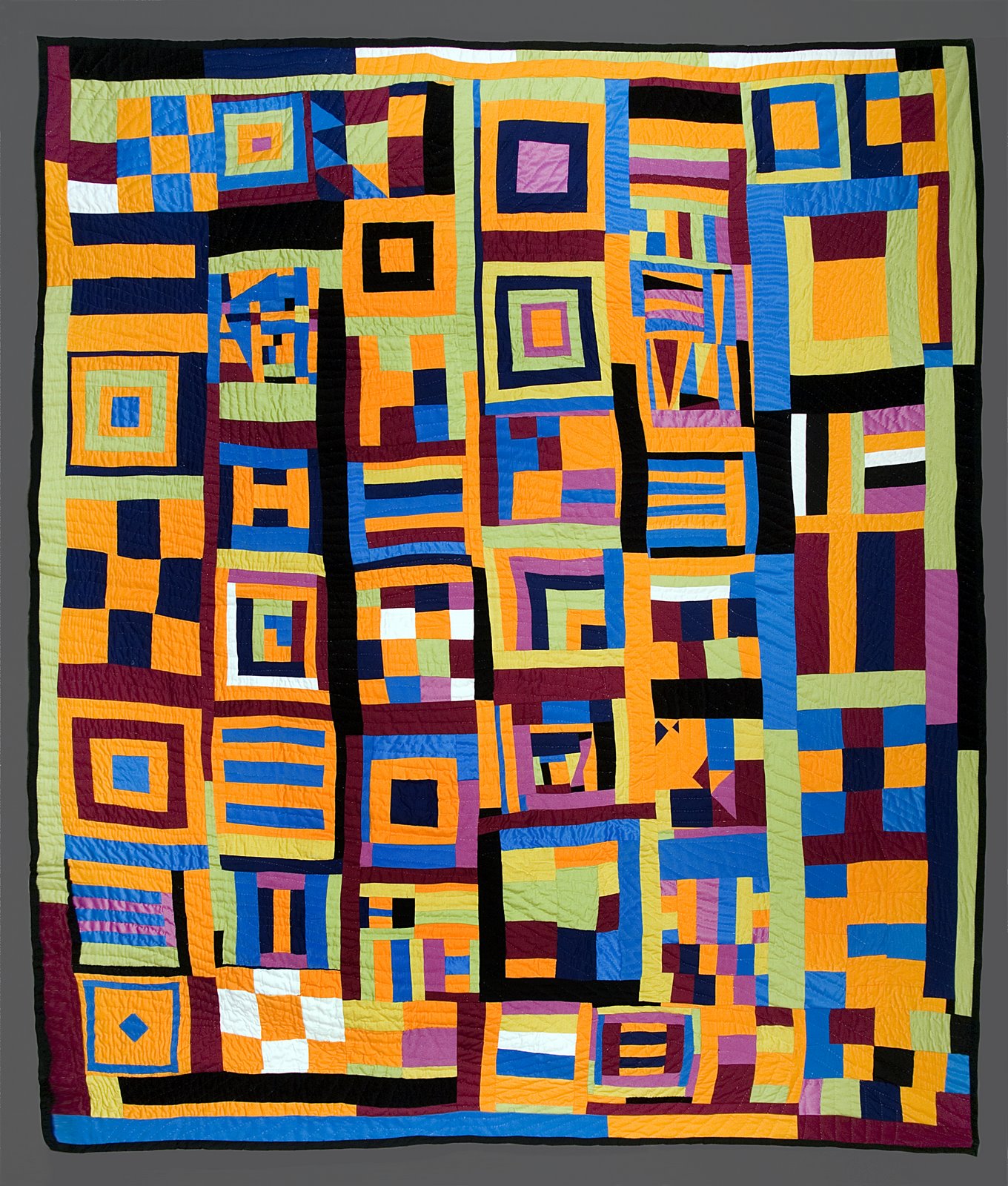
A Gee’s Bend Quilt
“People are following other people…people are trolling,” said Dr. Whitehead. “There’s something to be said about no longer writing your story.”
Dr. Whitehead encouraged students and faculty to be vulnerable and post about their passions. She explained that the Internet allows people to create different selves and gain the courage to say things they would not otherwise say if their name were made public.
The Internet offers many different platforms for users to share stories. Dr. Whitehead’s personal favorite is Twitter because of the anonymity it offers in addition to the availability of continuous content even if the user is offline.
“Twitter’s like a party…you can jump into it and see what’s happening, then leave and the party continues,” said Dr. Whitehead who even used the platform for a classroom project in which her students were to tweet every hour for 48 hours, and create a story out of the resulting tweets.
Whitehead explained that social media users are in control of the way they are seen on the Internet through what they post. Anything posted on social media is archived somewhere, and can be found through “googling” oneself, or going back on one’s Facebook timeline or Twitter feed.
“All the forms of media are connected,” said Dr. Whitehead, who said the Library of Congress archives tweets. According to the Library of Congress’ blog, it does in fact archive “Every public tweet, ever, since Twitter’s inception in March 2006…” Additionally, she mentioned a past student whose fourth grade paper made its way onto Google, and remains searchable to this day.
Therefore, anyone hoping to share his or her story can easily post it on social media, let it potentially go viral—if enough people see it—and have it remain on permanent record forever.
“It’s your story; it’s how you’re remembered,” said Dr. Whitehead. “You can only tell your story.”
Dr. Whitehead also emphasized the importance of responsible posting, and keeping intimate secrets private—that is, off the Internet altogether.
After her talk, Dr. Whitehead opened the room for questions. Several members of the audience were concerned with the millennial generation’s interpersonal skills, arguing that those were behind the technological loop had better interpersonal skills because they did not rely on technology to make friends or communicate with others.
Dr. Whitehead offered two answers, however she said she was uncertain of how technology would affect people’s communication skills in the future. The first was that technology helps people to interact, therefore improving interpersonal skills. The second was that technology invades people’s lives, making them incapable of being intimate with others or understanding true friendship.
“There’s a lot of tension around social media, there’s a lot of tension around the Internet, there’s a lot of tension around technology,” said Dr. Whitehead. “The millennials are here, and then after that we have the ‘say-nothing’ generation. They say nothing because technology says it for them…We may regret letting technology become so important, but we may not.”
Additionally, other faculty had questions about Dr. Whitehead’s teaching methods, which included occasionally using social media in the classroom. Dr. Whitehead is an assistant professor in the communication department and an affiliate assistant professor in African and African American studies department at Loyola. Her most recent book, Notes from a Colored Girl: The Civil War Pocket Diaries of Emilie Frances Davis, is the story of Emilie F. Davis, a free black woman from Philadelphia in the 19th century, written from the record she kept in her own diary. Dr. Whitehead argued that the record social media keeps of us could rival that of historical diaries, which we continue using today to gain insight into stories of the past.
*The quilt can be found at http://www.deepfriedkudzu.com/2008/02/gees-bend-quilt-commissioned-for-black.html
Related articles
- Social Media Policy: When Are Your Own Opinions Not Okay? (spinsucks.com)
Clip from “The Twin Towers: A History” dir.: Karsonya (Kaye) Wise Whitehead
2003 New York-Emmy nominated documentary film
directed & co-produced by Karsonya (Kaye) Wise Whitehead
“The Twin Towers have attained mythic status in the 21st century. The effect of their destruction and the tragic loss of life is engraved on the American consciousness.
Here is a fascinating history of the buildings that set the character of lower Manhattan and symbolized not only the power of New York City but American culture and financial dominance. The Twin Towers takes the viewer on an architectural journey that explores the design, construction and ultimate destruction of the 110-story buildings. Through interviews with architects, cultural historians, engineers and construction workers, a rich and absorbing story emerges.
It was David and Nelson Rockefeller who initially envisioned the development of lower Manhattan as the center for international trade. There is a certain irony in that they thought global trade would promote world peace. Japanese architect Minoru Yamasaki was chosen to design the World Trade Center, and despite some negative response toward the “spaghetti boxes,” most believed these two major buildings would usher in the 21st Century.
The film describes the technical problems that were overcome, including the challenge to the ironworkers. It also recounts the daredevil stunts that the buildings attracted. Paul Goldberger, renowned architecture critic, and others contemplate the future of the site.
“The commentary is insightful and the images are often fascinating.” Library Journal
“This insightful homage is a worthy addition to the burgeoning list of September 11 programs.” Booklist”
To purchase a copy of the documentary: http://www.amazon.com/The-Twin-Towers-Educational-Performance/dp/1463110316
 Karsonya (Kaye) Wise Whitehead #blackmommyactivist