Teaching In Baltimore City
©2013 by Karsonya Wise Whitehead
From 2005-2007, I worked as a middle school Advanced Academics Social Studies teacher at West Baltimore Middle School. As a mid-career changer (I worked as a documentary filmmaker for ten years), I did not really know what to expect when I walked into the classroom. I believed that I would encounter a room, full of excited students who wanted to immerse themselves in the study of American history. I envisioned two rows of students lined up at my door, dressed in white and blue starched linen dresses and shorts, carrying their writing tablets and instruments, and bringing me red shiny apples. I thought my students would love me and would see me as a fountain of knowledge and wisdom. This was my dream!
Unfortunately, my dream and my reality (which always happens to me) were not in anyway similar to one another. In fact, on the first day of school after fighting to get in the front door of my school, breaking up two hallway brawls, being called at least two of the words on my “Don’t Say” list, and accidentally bumping into a student who thought I was trying to frisk him, I realized that not only was this not my dream I actually felt that it was not my life! Those were the most difficult and most fulfilling years of my adult life. I cried almost everyday during that first year. I realized that these students—the ones who were angry and me and the world, the ones who could not read, and the ones who were growing up in extremely impoverished conditions—were the future. These students who struggled to understand even the most basic of concepts were one day going to be responsible for deciding the fate of the world.
I remember walking through the cafeteria while the students were forced to have yet another quiet lunch and realizing that I was afraid of the future that they were going to create. I could not understand how these students—who came to a school everyday that had bars on the windows, no doors on the bathroom stalls, no toilet tissue or soap, no vegetables or fresh fruit in the cafeteria, no books in the library or art supplies in the art room, no pencils, paper, or text books–could ever be trusted to create a world that I would want to live in.
I did not blame my students, as they don’t have control over the schools that they must attend, I blamed the system. I blamed the city and in so many ways, I blamed myself. I probably could have and should have done more, though at the time, I thought I was doing all that I could do. I probably should have stayed instead of going back to get to my Ph.D. and then escaping to the golden tower of academia. I could have and should have done more. If I want them to be able to create a world where I want to live then I must be willing to roll up my sleeves and work with them and for them to make their world (the one that I am currently creating) better for them.
My life was full of contradictions because even though I taught in the Advanced Academics program (there were 120 students in the program and 70% of them are currently attending college!), I worked in a school where most of the students were neither advanced nor interested in pursuing their academics. I remember when I was selected to receive the 2006 Maryland History Teacher of the Year Award because of my work with my students. I was both happy and sad: happy because my AA students were smart and confident and fully capable of carving out a life for themselves (because being smart and being recognized for being smart meant that they would have choices and opportunities); and I was sad because as hard as I worked for my 120 students, I did very little for the other 1000 students in the school who were reading below grade level and were not prepared to attend either a college-prep or a technical school.
In Baltimore City, by the time a student is finished with the first semester of their eighth grade year, they will know whether or not they will attend college. Since their high school acceptance is based upon their seventh grade test scores and the grades from seventh grade and the first semester of eighth grade, if they did not do well then they will not be accepted into either a city-wide (college prep) or technical high school. Their only choice is to attend their neighborhood (zone) school, where very few if any of the students go on to attend college. These are the students who scared me the most because by the time they became eighth graders, they knew that they were going to have very few opportunities to get the skills they would need to be successful in this world.
Even though I left, I think often of all of my fellow teachers who stayed behind to make sure that no child is left behind. This poem is for them and to them:
——————————————————–
Teaching in the inner city is not for the gentle-hearted:
it is not for those who need constant gratitude, extrinsic rewards or pats on the back
it is not for those who want to do something else.
It is not a job for the light-hearted:
for those who never see the light at the end of the tunnel or the peak at the top of the mountain;
for those who do not love our children almost as much as they love their own.
People who teach are different from those who have been called to teach our children:
the ones who have been labeled, left behind, looked over, forgotten, abused and disregarded…
the ones who live in communities where motherhood at 16 is a celebration and jail time by 20 is a rite of passage
Our children and those who have been called to teach them are the special ones;
They are the ones who are responsible for teaching our children not only how to speak but how to speak up and speak out.
Those who are called to teach inner city children are wired to wear and they can’t help but teach somebody something even when nobody is volunteering to learn.
They never get lost in a sea of unchecked papers, have never met a child they couldn’t teach, a lesson plan they couldn’t write, a challenge they couldn’t meet or an administrator they couldn’t tame.
They are professionals and can admit the system’s mistakes, own up to their own failures and state very clearly how it used to be, what it could be, and how it should be when it comes to educating our children.
These teachers are real and are uncluttered by the need for recognition instead preferring to do it right simply because it needs to be done…right.
They choose to teach on the edge of discovery…where creative ideas and our children tend to be.
Their work in its simplest form is sharing knowledge and giving back to the children that everybody usually takes from.
They are grounded, well planted oak trees whose branches are made up of the children that they have taught, saved and loved.
They guide our children safely from the sunset of learning to the sunrise of new beginnings.
Over time, we have learned that teaching our children and training them are two different things…those who are wired have found a way to do both.
©kaye whitehead
“Black History is American History” (2012 Baltimore Sun Op-Ed)
In 1926, Carter G. Woodson, through his organization, the Association for the Study of Negro Life and History (later renamed the Association for the Study of African American Life and History), founded and promoted Negro History Week. He selected February because Abraham Lincoln and Frederick Douglass‘ birthdays fell during this month. His desire was for Americans to recognize and celebrate the achievements and accomplishments of black people. The response was overwhelming, as black schools, black churches and black and white community leaders around the country rallied behind this call and pushed Negro History Week to the forefront.
In 1976, the celebration was extended to a month and became internationally known as Black History Month. Since then, the world has slowly changed — and because the racial, social and political landscape finally looks different, perhaps it is time for us to agree that this will be the last year we celebrate Black History Month.I have never been a supporter of Black History Month. Even as a young African-American girl growing up in Washington, D.C., I often wondered why we did not celebrate a White History Month or a Jewish History Month. Why just a Black History Month? Why did we need a special month where we could finally talk about black people?
I remember that the school cafeteria would always serve greens, fried chicken and cornbread and that the bulletin boards would have pictures of Martin Luther King Jr., Frederick Douglass, and Harriet Tubman (I dubbed them the “Big Three”). I was never taught about the accomplishments of black people at any other time during the school year. I never learned the full extent of black history; instead, for 12 years, I learned about this history in pieces: slavery was taught during week one, the civil rights movement was taught during weeks two and three, and during the final week we talked about King’s dream and how we should believe in it, accept it and try to live it.
The first year that I became a Baltimore City middle school social studies teacher was the last year that I celebrated Black History Month. At first, I followed the history curriculum, played it safe, and in February tried to cram 400-plus years of black history into one month. When I asked my students at the end of the month what they had learned about black history, one said, “So, Harriet Tubman was Frederick Douglass’ sister. She then married Dr. King and now they can ride in the front of the bus.”
Even though I knew that she was joking, I realized then that this is what happens when teachers try to condense history; dates and events are no longer important, they just focus on getting through the material. My students would never have confused George Washington with Abraham Lincoln or thought that the Civil War and the Revolutionary War happened at the same time. They were well versed in what they thought was the complete story of American history because they had been learning it all of their lives. The white American history that erased black people for 11 months out of the year was the only history that they knew.
I vowed then not to ever separate black history from American history again. It is one story that has many different parts, but the parts all work together. We are a nation that has come through slavery and have moved past legalized segregation, and though we are not yet living in a post-racial society, we are not where we used to be. We have witnessed a slow but steady change in American race relations, and things that were once taboo are now commonplace. I believe that the next step in our development is to reintegrate black history back into American history.
(I know that this will not be an easy task, because there are some people in America who would rather not teach or discuss anything other than white history. Such people — the ones who seem to be trapped in Plato’s “Allegory of the Cave,” creating their own version of reality — really must be dragged, kicking and screaming, into a better world.)
We should no longer celebrate or recognize Black History Month; instead, we should teach black history alongside white history, Asian-American history, Latino history, women’s history and others. By pulling all of these histories together, we can then finally call it what it is: American history. I am convinced that we will never become post-racial, or colorblind, or even better than what we are, until we do.
“The Torch is Ours”
Upcoming Media Appearances, Keynotes, Workshops, and Talks
Every Third Monday of the Month
WEAA 88.9FM at 7:40am
“Monthly Moments from a Historical Perspective” with Dr. Kaye Wise Whitehead
3-minute special highlighting a critical moment in American history (from 1863 and 1963)
*January 21, 2013
**Radio Appearance
WEAA Live Inauguration Special 88.9
12:30pm-2:00pm
Live show co-hosted by WEAA News Director and On-Air Personality Beverly Burke
90-minute special deconstructing American politics, President Obama and his second term, and the activities
WEAA Live inauguration special (Listen to MP3 audio recording, 100 min.)
January 28, 2013
**Radio Appearance
WYPR 88.1FM
12:00pm-1:00pm
“Midday with Dan Rodericks”
One-hour show discussing Black History Month, President Barack Obama, the Emancipation Proclamation, and the March on Washington
February 4, 2013
**Literacy Workshop
The Culturally Responsive Teacher
11:30am-1:30pm
Two-hour workshop connecting black history, education, the Common Core Standards, and cultural responsive teaching
February 18, 2013
**Radio Appearance
“Maryland Morning with Sheila Kast and Tom Hall”
Special segment connecting the Emancipation Proclamation with the March on Washington
February 26, 2013
**Keynote Address
Black History Month Special
U.S. Postal Headquarters
March 8, 2013
**Educational Workshop
Beyond Myths & Legends: Using Primary Sources to Document Harriet Tubman’s Activism
University of Albany
This interactive hands-on workshop will explore the ways in which educators can present Harriet Tubman’s social jusice activism and her legacy in the context of rediscovering and reconstructing her historical narrative through the use of primary sources and storytelling in the digital classroom.
March 23, 2013
**Keynote
Women’s Leadership Workshop
Timonium, MD
Henceforth and Forever Free
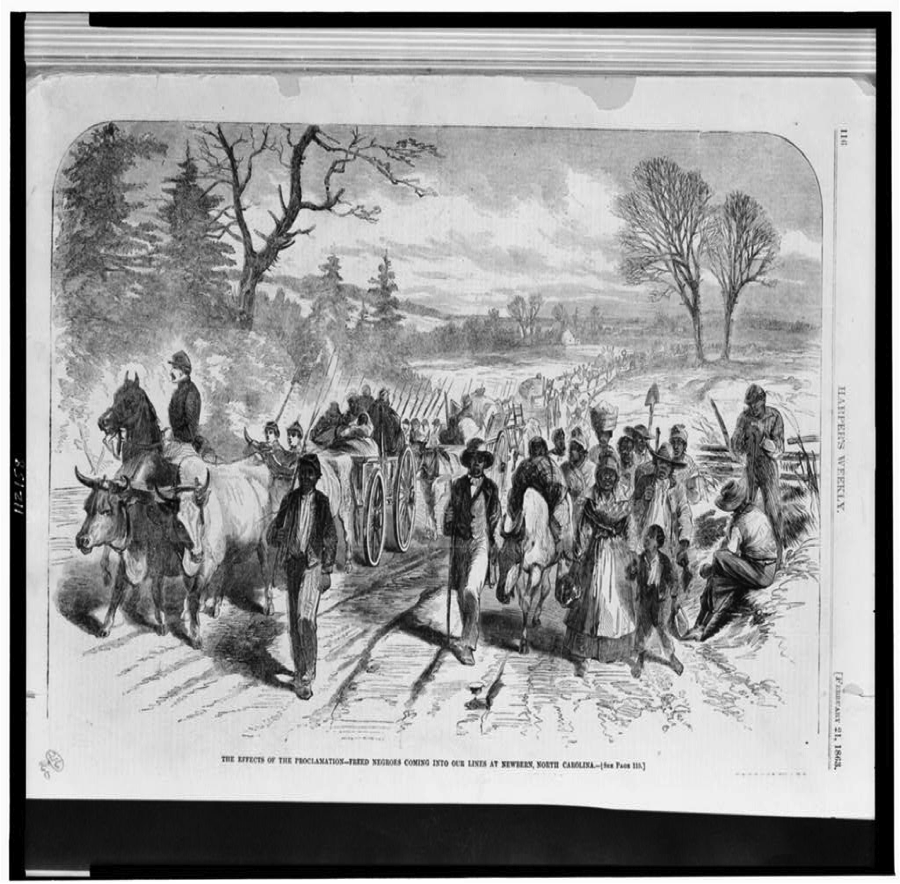
I must admit, that in so many ways, I still do not get the Emancipation Proclamation. I have studied it for years, written about it extensively in my forthcoming book, taught it in my class, and explained it to my sons but inside I still do not get it. It is hard for me, with my 21st century lens, to look back at this pivotal moment and really understand what it meant for enslaved men, women, and children to realize that freedom had finally come. I think that it is hard for me to understand freedom because I do not really understand what it means to be enslaved. I understand it intellectually but beyond that, no matter how much I try, I cannot fully comprehend what it means to be “owned” by someone. Slavery was an albatross, a weight around the neck that kept a person bound to their plantation owners from their cradle to their grave. By 1863, slavery had been the way of life in America for more than 200 years and countless numbers of black people had lived and died without ever experiencing a day of freedom. I have been thinking a lot about this since September 22, when I started mentally counting down the days until the 150th anniversary of the release of the Emancipation Proclamation. There are times when I can barely contain my emotions as I think about how my ancestors (those who knew about the document) must have felt as they counted down the days. It must have been difficult, as the country was not completely sure if Abraham Lincoln, a moderate antislavery Republican who had struggled both privately and publically with the issue of enslavement, was going to officially release the Proclamation. Even though this was both a political and a social statement, Lincoln did not intend for it be viewed as a pro-black benevolent document. It was a war tactic and he even waited until after a Union victory to first announce it. This did not matter to the black community because they defined it and viewed it as much more than just that. As historian Jacqueline Jones explains it, emancipation “was not a gift bestowed upon passive slaves by Union soldiers or presidential proclamation; rather, it was a process by which black people ceased to labor for their masters and sought instead to provide directly for one another.” I define it as the first wobbling step towards agency, that moment when they stopped thinking of themselves as property and began to think of themselves as people.
With all of the tension and the uncertainty of the moment, on December 31, 1862, black and white America counted down the minutes until the Proclamation would either take effect or be removed. Many spent the Watch Night in prayer and turmoil, while others celebrated, confident that freedom was at hand. My father is a pastor and I grew up attending Watch Night Services. I remember sitting in the cold pews at 11:50 pm as the deacons would slowly start to dim the lights. My mother would pull us out of our seats so that we could kneel on the floor as my father would lead the church in prayer. He would always begin by giving thanks for freedom, mentioning both the Emancipation Proclamation and the ending of Jim Crow. He would remind us that we came from people who chose to survive despite the overwhelming odds against them. “We are a strong people,” he would say, “and freedom wasn’t just given to our ancestors, it was something that they took as well.” The lights were turned on right after midnight when my father would say, in a resounding voice, that we were, “Free. At. Last.” Matilda Dunbar, the mother of poet Paul Lawrence Dunbar, described it in similar terms when she noted that on the day she heard she was free, “I ran ’round and ’round the kitchen, hitting my head against the wall, clapping my hands and crying, ‘Freedom! Freedom! Freedom! Rejoice, freedom has come!'”
I have been trying to explain freedom to my sons who now participate in Watch Night Services and watch me cry as I struggle to understand what it means. I realize that I may never really get it but every year on December 31, I will pause and give thanks for it and for never having experienced a day without it.
CFP: The Golden Jubilee of the Civil Rights Act
Association for the Study of African American Life and History (ASALH)
Black History Bulletin
Theme: “The Golden Jubilee of the Civil Rights Act”

Lyndon B. Johnson signs the Civil Rights Act of 1964. Among the guests behind him is Martin Luther King, Jr.
ASALH’s Black History Bulletin (BHB) Issue 76#2 will focus on deconstructing and exploring the modern Civil Rights Movement. Papers addressing any topics or events related to the Civil Rights Movement will be considered, special consideration will be given to papers that address the 1964 Civil Rights Act and the Letter from a Birmingham Jail.The Black History Bulletin is dedicated to enhancing teaching and learning in the areas of history. Its aim is to publish, generate, and disseminate peer-reviewed information about African Americans in United States history, the African Diaspora generally, and the peoples of Africa. Its purpose is to inform the knowledge base for the professional praxis of secondary educators through articles that are grounded in theory, yet supported by practice. The BHB welcomes articles and lesson plans (including pullouts, ranging from teacher “how-to” to biographical and/or informational pieces about African Americans for students to read) written with a focus on: 1) middle school history; 2) high school history; 3) teacher preparation in social studies methods
Articles should be no more than 7 double-spaced pages, including endnotes. Cover letter should include the title of your manuscript, your name, your postal address, email address, phone number, and fax number. The Chicago Manual of Style must be used for citations.
Direct all queries to the guest editor:
Kaye Wise Whitehead, Ph.D.
Loyola University Maryland
4501 North Charles Street, CTM014K
Baltimore, MD 21210
(410) 617-2435
E-mail: kewhitehead@loyola.edu
Twitter: @kayewhitehead
Webpage: https://kayewisewhitehead.com/
Deadline for submission of articles and lesson plans is 02/28/13
Emilie Davis, Her Life, In Her Own Words: 1863-1865
forthcoming: University of South Carolina Press, 2013
Call for Papers: “At the Crossroads of Freedom and Equality: The Emancipation Proclamation and the March on Washington”

The March on Washington for Jobs and Freedom
ASALH’s Black History Bulletin (BHB) is planning for a special issue to commemorate both the March on Washington and the Emancipation Proclamation.
The Black History Bulletin is dedicated to enhancing teaching and learning in the areas of history. Its aim is to publish, generate, and disseminate peer-reviewed information about African Americans in United States history, the African Diaspora generally, and the peoples of Africa. Its purpose is to inform the knowledge base for the professional praxis of secondary educators through articles that are grounded in theory, yet supported by practice. The BHB welcomes articles and lesson plans (including pullouts, ranging from teacher “how-to” to biographical and/or informational pieces about African Americans for students to read) written with a focus on: 1) middle school history; 2) high school history; 3) teacher preparation in social studies methods
Articles should be no more than 7 double-spaced pages, including endnotes. Cover letter should include the title of your manuscript, your name, your postal address, email address, phone number, and fax number. The Chicago Manual of Style must be used for citations.
Direct all queries to the guest editor:
Kaye Wise Whitehead, Ph.D.
Loyola University Maryland
4501 North Charles Street, CTM014K
Baltimore, MD 21210
E-mail: kewhitehead@loyola.edu
Deadline for submission of articles and lesson plans is 02/28/13
November 15, 2012: History Workshop at Morgan State University
Topic: Notes from a Colored Girl: The Pocket Diaries of Emilie F. Davis, 1863-1865
Discussion: Using primary sources to reclaim, restore, and discover voices from the past
*Focus era: The Emancipation Proclamation
-Place: HOLMES 112, 4:30-7:15 PM
*Join me for a lively discussion on how to become a forensic historical investigator (FHI).
NWSA’s “Why Women’s Studies”
Inspired by projects I Need Feminism and Why Feminism? and others across the country, NWSA asked attendees to answer the question “Why Women’s Studies?” at the NWSA 2012 annual conference Feminism Unbound: Imagining a Feminist Future in Oakland, CA November 8 -11. Check out the preview (I show up at six seconds and again at 40 seconds):
Status Report: “Notes from a Colored Girl: The Pocket Diaries of Emilie Davis 1863-1865”
This book is currently in the pipeline at the University of South Carolina press and is scheduled to be released in August 2013.
Synopsis: This manuscript analyzes the 1863-1865 pocket diaries of Emlie Davis, a nineteenth-century freeborn black woman, as a “port of entry” through which I examine Emlie’s place within the free black community, her worldviews and her politics, her perceptions of both public and private events, and her personal relationships. Her daily entries are used as a starting point to investigate, explore, and reconstruct a narrative of her life. Emlie’s pocket diaries provide a skeleton blueprint of her life that outlines her mobile subjectivity, particularly in relation to the people, incidents, and ideologies that shaped and formed her identity. An analysis of Emlie’s story provides a dialectic between the lives of mulattoes and black, activism and grassroots work, and fluency and literacy. Read more…
 Karsonya (Kaye) Wise Whitehead #blackmommyactivist