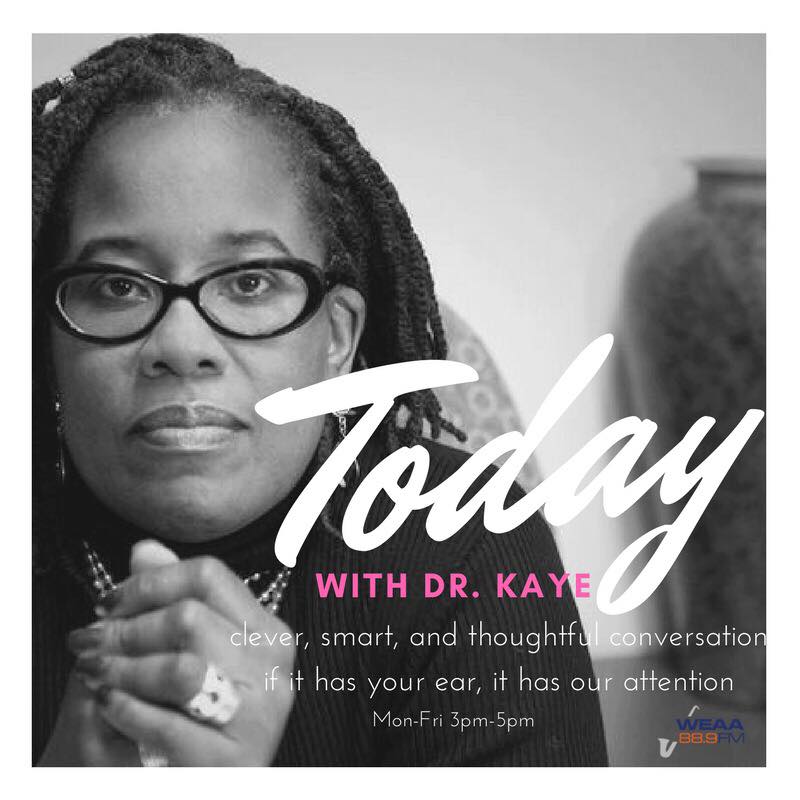
Dr. Karsonya “Kaye” Wise Whitehead is a historian of Black life in America whose work explores how Black history is remembered, taught, and carried into the present. She is a professor of Communications and African and African American Studies at Loyola University Maryland and the founding executive director of the Karson Institute for Race, Peace & Social Justice, where her work brings scholarship into conversation with public history, education, and community life.
Whitehead hosts the award-winning radio show Today With Dr. Kaye on WEAA 88.9 FM, where she brings historical perspective to conversations about some of the stories that matter in American life. Her work in radio and journalism has earned two Regional Edward R. Murrow Awards, multiple Chesapeake Associated Press Broadcasters Association Awards, and the Vernon Jarrett Medal for Journalistic Excellence.
Dr. Whitehead also serves as the 30th president of the Association for the Study of African American Life and History (ASALH), founded by Dr. Carter G. Woodson in 1915 and the nation’s oldest organization dedicated to the study and promotion of Black history.
An award-winning author of five books, Whitehead’s scholarship includes Notes from a Colored Girl: The Civil War Pocket Diaries of Emilie Frances Davis, which received the Darlene Clark Hine Book Award from the Organization of American Historians and the Letitia Woods Brown Book Award from the Association of Black Women Historians. Her most recent book, my mother’s tomorrow: dispatches through the lens of Baltimore’s Black Butterfly, examines Black life, place, memory, family, and community through the lens of Baltimore.
Before entering academia, Whitehead worked as a documentary filmmaker and television producer, including as a senior producer for MTV, and received three New York Emmy nominations. She holds a Ph.D. in Language, Literacy, and Culture from the University of Maryland, Baltimore County, an M.A. in International Peace Studies from the University of Notre Dame, and a B.A. in history from Lincoln University, PA. She is a member of Delta Sigma Theta Sorority, Inc,
Whitehead has delivered more than 950 keynote addresses nationally and internationally. Across her scholarship, teaching, public history, media work, and institutional leadership, she continues to examine the ways Black history lives beyond the archive—shaping the stories we tell, the communities we build, and the America we are still becoming.

